
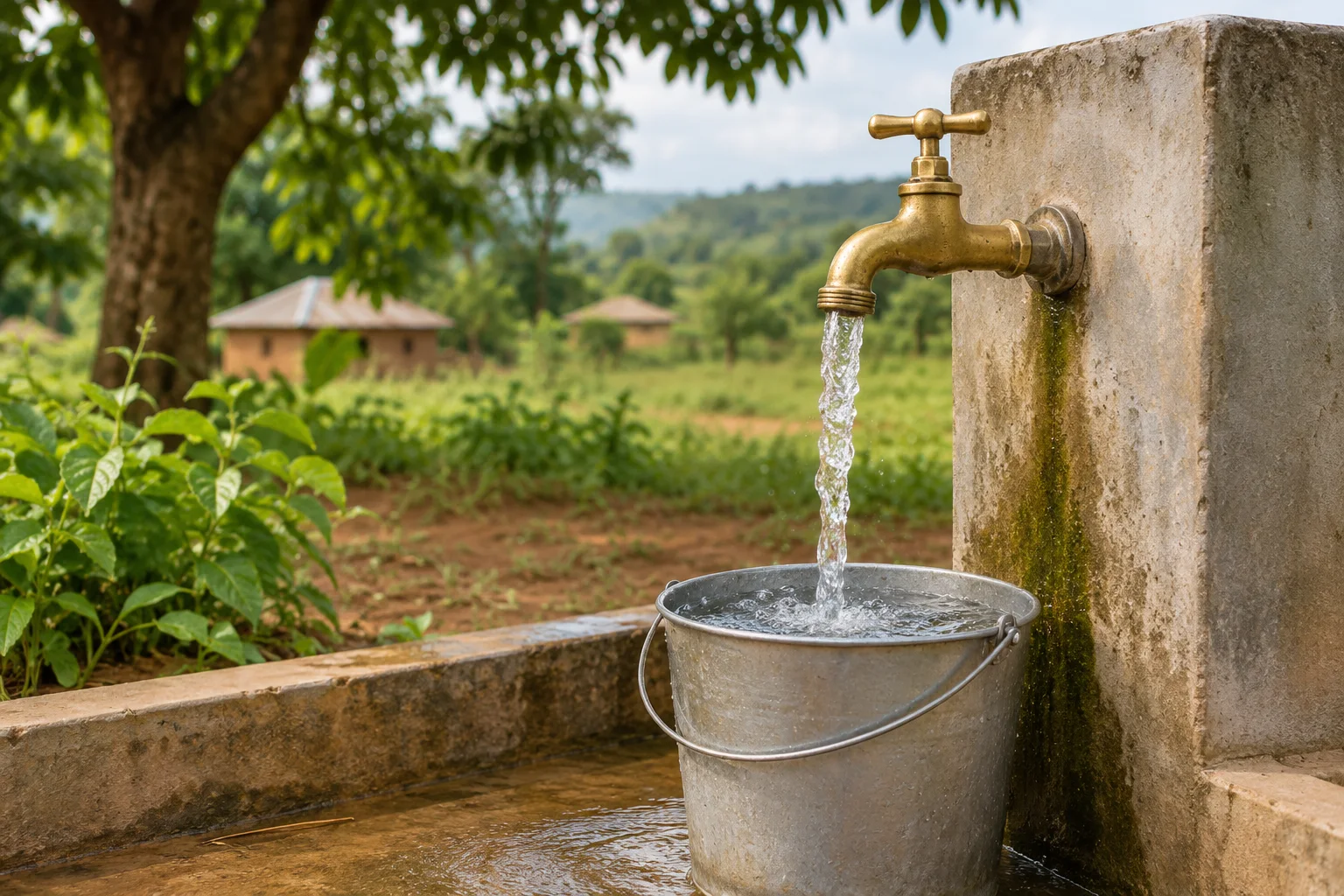
A water installation can be photographed on the day it opens. Its long-term value is established on ordinary days: when households need it, when demand changes and when a component fails.
Turning the goal of reliable water into a workable programme requires an assessment of current services, the people they reach and the institutions responsible for keeping them working.
The available discussion material does not establish a verified list of water projects, locations, budgets or delivery dates. Those details should follow evidence and technical planning. The broader question is already clear: what would dependable and fair access require?
THE IDEA, AT A GLANCE
A service has a life beyond installation
- AssessUnderstand current access and technical conditions
- DesignCompare suitable options and full costs
- OperateAssign responsibilities and resources
- MaintainPlan repairs, review quality and keep records
Map services before announcing installations
A useful assessment would record existing sources and systems, their operating condition, who uses them and who manages them. It should distinguish an installed asset from a functioning service.
Residents’ accounts can identify interruptions and practical difficulties. Operators can help explain maintenance, supply and management constraints. Technical assessment is needed to establish source suitability and appropriate service options.
The resulting picture should include people who are poorly served, rather than only the locations easiest to reach. Distance, accessibility, opening arrangements and the cost of obtaining water all belong in the assessment.
Choose a solution that fits the setting
Different places may require different approaches. Repairing an existing system, extending a service or evaluating a new source each raises its own technical and financial questions.
No single technology should be treated as a universal answer. A proposal needs to examine availability, demand, operating requirements and environmental considerations with qualified specialists. Where land or shared access is involved, agreements must be clear before construction begins.
Comparing options also makes opportunity costs visible. A new installation may attract attention, while repairs or management improvements could restore service sooner. The choice should be explained through evidence about the expected benefit and continuing cost.
Make maintenance part of the first budget
An operating plan should identify who inspects the system, who handles routine work, how repairs are funded and where replacement parts or technical support can be obtained.
These responsibilities should be assigned before handover. An informal assumption that the community will maintain an asset can leave everyone responsible in principle and no one able to act in practice.
The plan also needs to address larger failures. Routine collections may cover small repairs while being insufficient for major replacement. A realistic financing arrangement should distinguish those needs and identify what happens when local resources cannot meet them.
Discuss affordability and sustainability together
Water charges affect access, while operating costs affect continuity. A programme should examine both rather than assume that one question resolves the other.
Where fees apply, users should understand how they are set, what they fund and how payments are recorded. Any support for households unable to pay needs a defined and sustainable arrangement. An exemption promised without funding may shift the burden elsewhere or weaken the service.
Public financial information can help users assess whether charges and expenditure are reasonable. Complaints should have a route beyond the person collecting money, especially where there is a dispute about service or payment.
Treat quality as an ongoing responsibility
The existence or appearance of a source does not establish its safety. Water-quality arrangements should follow the relevant professional and regulatory requirements, with responsibility for testing and corrective action made clear.
Users need understandable information about the service and any verified restriction on its use. Testing should not be a one-time ceremonial step whose findings disappear after launch.
Sanitation, waste and drainage also deserve consideration when a system is planned. These connections require technical assessment; they should not be reduced to assumptions based on a brief site visit.
Give users a role without transferring every burden to them
Community participation can help shape service hours, access arrangements and ways of reporting faults. It should include people who use the service under different conditions, including those who may find meetings difficult to attend.
A management committee, where appropriate, needs clear responsibilities and financial controls. Membership alone does not provide technical capability or authority to resolve every failure.
Users should know what they can decide, what requires the operator and what must be escalated. A visible fault-reporting process can make that division practical, provided the responsible institution has agreed to use it.
Connect parliamentary attention to responsible delivery
County functions include water and sanitation services, alongside relevant national responsibilities in water resources and policy. [1] A constituency’s water priorities therefore need coordination with the appropriate institutions and operators.
An MP’s contribution could include pursuing documented concerns, relevant national questions and partnership discussions. Ownership, technical approval, operation and maintenance still need explicit institutional arrangements.
Public updates should describe those arrangements accurately. A proposal, a funding discussion, an approved project and a working service represent different stages.
A cheaper installation can become a more expensive service
A low initial cost is attractive when resources are scarce. It may be misleading if the option needs frequent repairs, costly energy or parts that are difficult to obtain. A more expensive installation can also be poor value if demand or technical suitability has been overstated. The comparison must cover the service over time.
Users may reasonably prefer low charges; operators need resources to keep the system functioning. A proposed subsidy should identify a dependable funding source and how the benefit reaches intended users. An unfunded promise of free water can leave a scheme unable to repair itself, while a poorly designed charge can exclude households from access.
An options assessment should therefore show the expected service level, technical assumptions, continued costs, responsibility for major repairs and arrangements during failure. Qualified professionals should establish the appropriate design. Community discussion should then consider those findings in understandable terms, including how the least convenient option for an operator might affect the people living furthest from a supply point.
Assess the service people receive
A useful review could examine reliability, accessibility, repair time, quality checks, affordability and the handling of complaints. Those measures should start from an established baseline rather than an invented target.
Funyula’s water discussion can then focus on a service that continues to meet needs over time. The installation matters, and so do the people, resources and responsibilities that keep it useful after the opening day.
Further reading
[1] Kenya Law Reform Commission — Fourth Schedule: County functions, alongside the Constitution’s national functions.